
Spain produces some of the most technically gifted footballers in the world, so it is no surprise that families from every continent ask the same question: which are the best football academies in Spain, and can my child actually join one? The honest answer is that the best football academy for an international player is not always the most famous one. The best-known clubs mostly recruit through their own scouting networks, while a growing number of programs are built specifically for players arriving from abroad.
This guide looks at the best football academies in Spain through that international lens. For every academy we cover whether it offers boarding, whether it welcomes international players, which language players work in, and which passport or visa rules apply. If you are specifically interested in residential programs that offer a combination of football and high-school academic, see our full guide to football boarding schools in Spain for a side-by-side comparison of popular options.
Whether you are looking for a football academy in Spain for international students for a full season or a shorter first step, the sections below explain which types of program exist, how we chose the academies, and what each one means for a family moving from outside Spain.
Understanding the three main program types makes it much easier to compare academies fairly. Each one works differently on the pitch and off it, and each suits a different kind of player.
The player joins a professional club’s own official academy team and lives at the club’s residence, training alongside the players who came through the club’s own system. It is the deepest form of immersion and the most demanding. The main trade-off is that an international player inside an elite club’s own team can find it harder to obtain the license needed to play in official matches. Examples of this type of program is the Atletico de Madrid Academy which offers direct immersion to international players within their academy teams through boarding school or high-performance camp programs, or the Athletic Club Bilbao residential boarding programs at Lezama, their official training centre.
What this means for international families: expect Spanish to be the everyday language, a high competitive bar from day one, and passport rules that can shape how long a player can stay.
A professional club develops an official program that brings international players together to form their own team. Training sessions may take place on the club’s official training ground premises, with other sessions held at a separate training locations. Qualified, experienced coaches lead the team throughout the season, with involvement from official coaches of the affiliated professional club. Players typically live in a residence with the other international players in the program.
What this means for international families: a shared international peer group, English-language support is more common, and there is often a clearer route for non-EEA passport holders.
These academies are privately run and not tied to a single professional club. They form squads from several nationalities and set their own admission and training criteria. Some partner with lower-division local clubs, so players follow the academy’s own training system while also competing for a local or regional team. Players live in a residence with the other international players in their squad.
What this means for international families: players are part of a private football academy with exposure to official Spanish teams through the local club partnerships or participation in friendly matches or top international tournaments. The programs and teams are designed around players arriving from abroad and local players from the surrounding area.
All three types are available in both a football boarding school format (a full season or a term) and a shorter high-performance camp format. A short camp is often a sensible first step if your family wants to see an academy in person before committing to a full year.
Below is a table of various of the best football academies in Spain for international players. The different table columns compare different characteristics of the programs.
| Academy | Program type | Location | Boarding | Passport / visa | Main language |
|---|---|---|---|---|---|
| Atlético de Madrid | Direct academy immersion | Madrid | Yes | Longer stays please confirm with our team | Spanish / English |
| Getafe CF / GIMFA | Club-affiliated international | Madrid | Yes | All nationalities, visa support for non-EEA | English |
| Kaptiva Sports Academy | Independent international | Sant Cugat, Barcelona | Yes | All nationalities | English |
| WOSPAC Academy | Independent international, linked to UE Cornellà | Barcelona | Yes | All nationalities, visa and NIE management | English (IB / American) or Spanish / French |
| Athletic Club Bilbao | Direct academy immersion | Lezama, Bilbao | Yes | Confirm with our team | Spanish, with support classes |
| Baskonia Alavés Academy | Club-affiliated international | Vitoria-Gasteiz | Yes | Confirm with our team | Spanish; academics via partner schools |
| Villarreal CF Player Development Program | Club-run international program | Vila-real | Yes | Confirm with the club | Spanish; confirm English support |
| IDA Valencia | Independent international | Valencia area | Yes | Confirm with the academy | English coaching plus Spanish lessons |
We know each program and can guide your family through availability, requirements and applications.
Atlético de Madrid is a clear example of direct academy immersion. Players are placed into official academy teams that match their level and train under the club’s own coaches, rather than in a separate international group. That is a powerful development environment for players who are ready for it, and Spanish picks up quickly when it is the language of the dressing room and the residence.
Two points matter for international families. First, passport rules shape the length of the stay: EEA passport holders have easier access to the longer programs, while non-EEA players may require additional steps, so please contact our team for any questions or help to confirm eligibility directly with the Club before you plan the year. Second, the program is educational and formative and does not lead to an official federation license for competitive matches or a route to a club contract. Families who want match competition will want to weigh that carefully.
Explore the Atlético de Madrid boarding school program
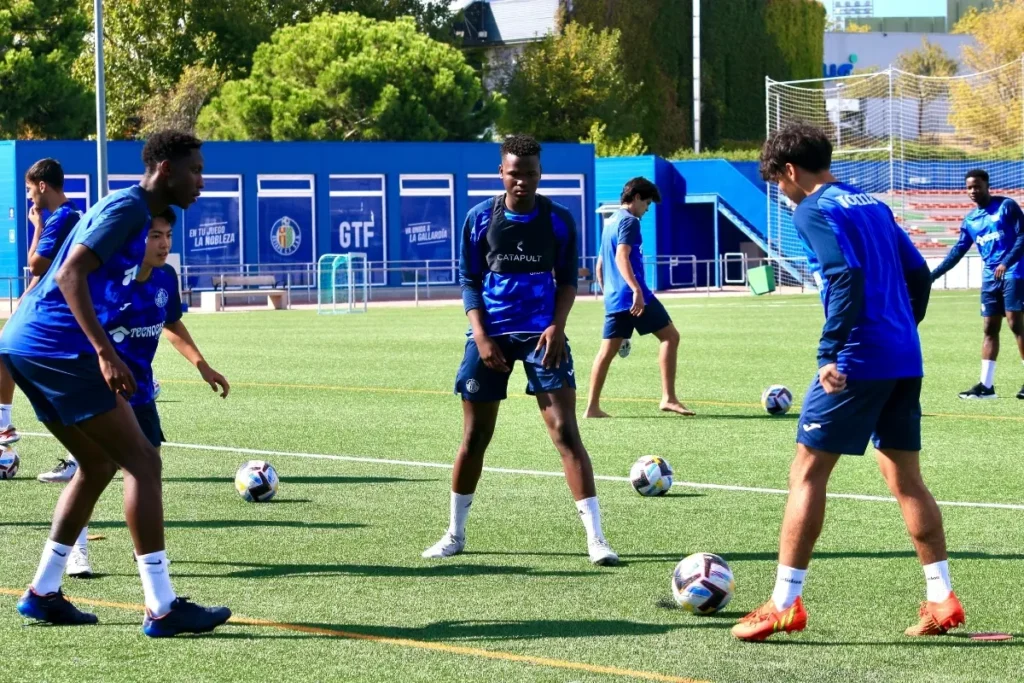
GIMFA is an official Getafe CF program built around international squads. Players train five days a week under UEFA Pro Licence coaches endorsed by Getafe’s first-team staff, and official Getafe academy coaches attend sessions to evaluate players. Top performers can be considered for promotion into Getafe’s own academy teams, subject to FIFA regulations, so it is a genuine but competitive pathway rather than an expectation.
For international families the practical strengths are clear. Full visa and residency support is available for non-EEA students, classes are taught in English, and the peer group is genuinely international, which makes the first months easier for players who do not yet speak Spanish. A good level of English is required. A dedicated goalkeeper specialisation program is also available.
Explore the Getafe CF boarding school program
Kaptiva has been developing international players since 2012 and runs on its own training system. Players take part in around 30 games through the Catalan Football Federation, plus tournaments and tours, which gives real match exposure to the standard of Spanish youth football. Admission is based on a football résumé and a trial.
For families arriving from abroad, the main advantages are an English-language academic route, a blended learning model that flexes around match schedules, and a strong support structure of residential monitors, a nutritionist, mental coaches and a player app that keeps parents informed. It is a natural fit for players interested in the US college pathway.
Explore the Kaptiva Sports Academy program
WOSPAC has operated for more than 15 years and has trained over 10,000 players from around the world. Its official partner club is UE Cornellà, and players who obtain their license can compete in official matches with the local team. Programs range from one week to a full season, so it works both as a first visit and as a long-term base.
Two things stand out for international families: the flexibility of the program length, and the age range, which is wider than most (12 to 25). Configurations are available for players who need visa and NIE management as non-European passport holders, and for players who want a training-focused placement rather than school-integrated education.
Explore the WOSPAC Academy program
Athletic Club runs one of the best-known academies in world football, and its international boarding service gives selected players the same treatment as a young player from the club’s own structure. Players are placed with an Athletic affiliate team that matches their age and characteristics, attend sessions with the Athletic Club Football School (Athletic Club Eskola) and follow an individual training plan led by the club’s coaching staff.
Language is the key consideration. This is a Spanish-speaking environment in the Basque Country with immersion in the academy teams, so the adaptation course and Spanish lessons matter. However, for residential boarding school programs the club also offer English and French taught academic tracks. Players live directly on the training complex, sharing leisure areas with the club’s own academy players, and access to La Liga matches at San Mamés is part of the experience. Please confirm current eligibility for your child’s passport with our team.
Talk to us about Athletic Club Bilbao
The Baskonia Alavés Academy is promoted by the Baskonia-Alavés Group, which manages both Deportivo Alavés in football and Saski Baskonia in basketball. Training follows the Deportivo Alavés high-performance model, and players attend matches in both sports, which gives the program a distinctive dual-sport character.
For international families, the flexibility is the headline: programs run from one week to a full ten-month season, so it can be a low-commitment way to try Spain before a longer stay. Inclusions cover airport transfers from Bilbao, health insurance and match tickets. Because academics are arranged separately through partner institutions, families should plan the school side with us early.
Talk to us about the Baskonia Alavés Academy
Villarreal CF’s Player Development Program is a residential program in Vila-real that lets young players from overseas train and develop within an elite club environment. According to the club, 33 players from across the globe took part in the recent season, and the program places emphasis on education and cultural integration.
Talk to us about the Villareal CF Player Development Program
IDA Valencia is an example of an independent international academy that builds its own squad and places players with partner clubs at lower levels for competitive matches. It is aimed at older players, so it is a different proposition from the under-18 boarding programs above.
Talk to us about the IDA Valencia International Development Academy
The list would not be complete without mentioning FC Barcelona and Real Madrid. These Clubs offer programs for international players but at official branded academies around the world or shorter weekly programs at their training centres in Spain, rather than month or season-long in-house residential boarding and training programs.
FC Barcelona’s youth system is one of the most admired in the world. It typically builds its squads by scouting players years in advance, most often those already based in the area, and there is no season-long international programs for families from abroad. Rules on the international transfer of minors limit which young players a club can sign from overseas. Families drawn to Barcelona as a city can look at the independent academies based there, such as Kaptiva and WOSPAC, above.
Real Madrid’s academy follows a similar model to FC Barcelona: players are identified through the club’s scouting and typically join at the club’s invitation or through official branded academies around the world. The club does offer short-term weekly camps in Spain but does not offer residential year-long boarding or football training programs for international families from abroad. For a family that wants to base their child in Madrid, the Atlético de Madrid and Getafe programs above are the international entry points we work with directly.
Every academy above is a different fit for a different player and their family. Before you shortlist, these are the international-specific questions worth answering first.
Yes, but how depends on the type of academy. The youth systems of major clubs such as FC Barcelona and Real Madrid mostly recruit through their own scouting, so they are hard for families abroad to join. Other options are open to international players by design: official international programs run with clubs such as Atlético de Madrid, Getafe CF and Athletic Club, and independent academies such as Kaptiva Sports Academy and WOSPAC. Entry usually involves a video review or a trial.
At many of them, yes. Atlético de Madrid, Getafe CF / GIMFA, Kaptiva Sports Academy, WOSPAC, Athletic Club Bilbao and the Baskonia Alavés Academy all offer residential accommodation. Some day academies, including FC Barcelona and Real Madrid, do not run season-long boarding programs for international families. A few programs, such as Villarreal CF’s Player Development Program, use host families instead of a residence. For a comparison of residential options only, see our guide to football boarding schools in Spain.
It depends on the academy. Some programs are taught in English, especially those comprising of international academy squads with boarding programs following the English-language IB and American curricula. More immersion programs are mostly in Spanish due to training in official academy teams. Some programs with boarding programs also offer French-taught academics through local schools. On the pitch, most players find they pick up football Spanish quickly.
The process usually follows the same steps. First, tell us about your player: age, level, passport, academic situation and goals. We recommend the programs that fit and explain the requirements. Next, most academies ask for a video or a trial to confirm level. Once a place is offered, we guide you through the application, and families from outside the EU begin the student visa process. There is no cost to enquire and no obligation to proceed.
EU and EEA passport holders do not need a visa. Families from outside the EU will need a student visa, and the requirements and timelines vary by nationality. Some programs offer visa and residency support, while others limit how long non-EEA players can stay. You can always reach out to our team to confirm eligibility and inform us of your child’s nationality so that we can verify the requirements for you with the academies before applying at no cost.
Yes, at some of them. Availability varies by program and age group, so it is best to contact us to confirm current options.
For most players, no program can promise that. What the best programs offer is professional coaching, real match exposure and visibility in front of club staff, which give a player the strongest foundation for whatever comes next, whether that is a professional contract, a college scholarship or reaching their own ceiling. We would encourage you to be wary of any program that guarantees an outcome.
Choosing among the best football academies in Spain depends on your child’s age, level, passport and academic goals, and there is no single answer that fits every player. Tell us about your child and we will recommend the programs that fit, explain the requirements and guide your family through every step. There is no cost to enquire and no obligation to proceed. If none of our programs is the right fit, we will tell you honestly.
Fill in the form below to contact our team directly for any questions you have on any of the programs or for guidance and advice for your family’s situation. Our team is happy to help and connect you directly with these programs.
To help you make an informed decision about your child’s football training and education, we encourage you to explore the following resources:
PSG Academy Pro Residency vs. Atlético de Madrid: Which Is Right for Your Child?
The Ultimate Guide to Football Boarding Schools for Parents
Choosing between an International Football Boarding School or a Local Football Academy
Best Football Boarding Schools in Madrid
Atlético de Madrid vs. Getafe International MFA — Which Is Right for Your Child?