
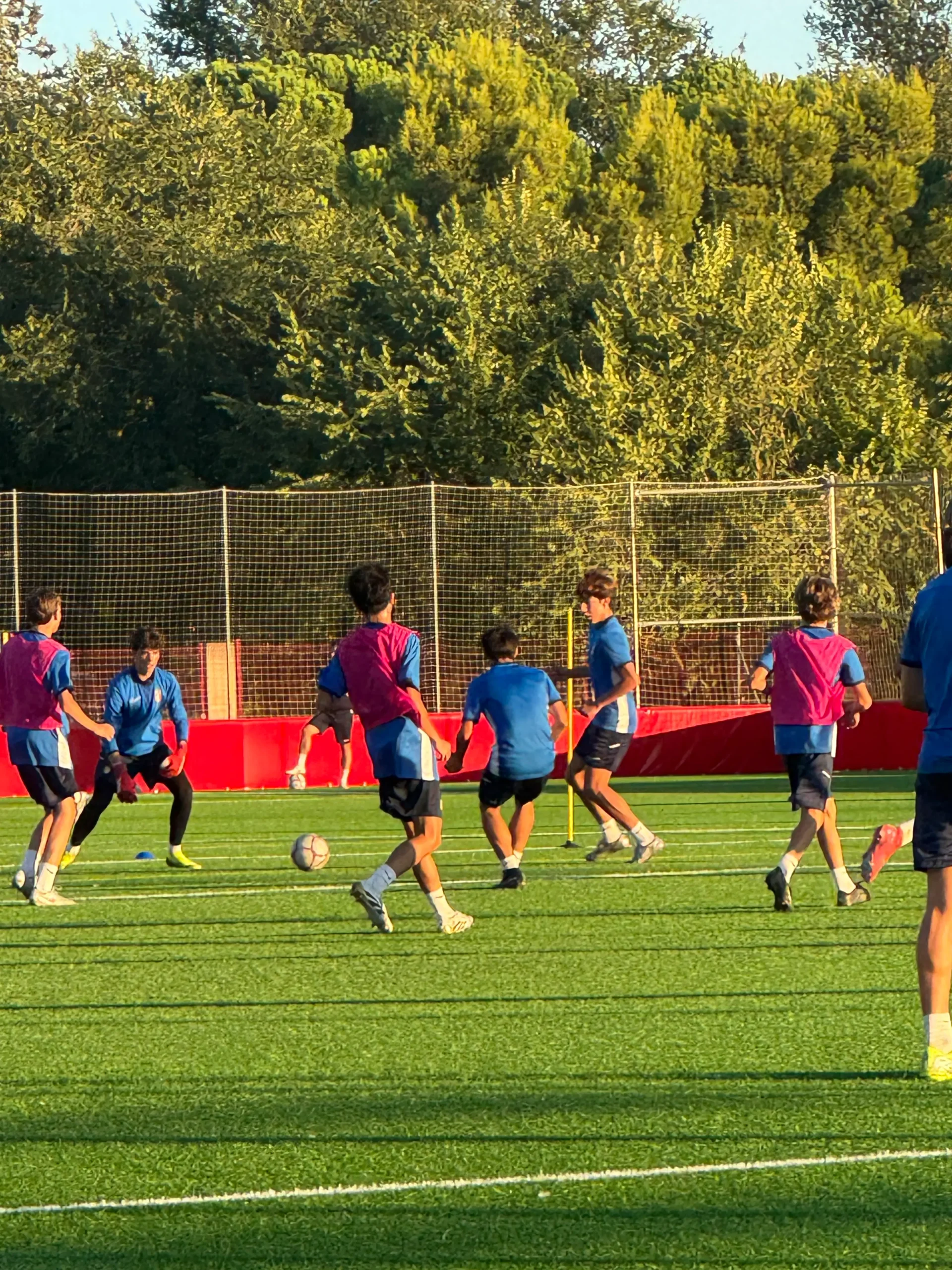
As part of our work advising families on football boarding schools at international academies, we regularly hear from parents whose child is already playing football at a high level in their home country.
After strong development in their domestic league, they tell us that they are now looking to take the next step for their child’s football.
And they are considering international academies where they can be immersed in an elite environment combining expert football training and academic secondary school studies. If this is also your case, make sure to read on.
The search for the right international academy is exciting, but it takes time, and it usually means comparing several programs closely. Partway through that process, many parents are surprised to learn something important: if your child joins certain international academies, they will not be able to obtain a federation license in order to play official federated league matches while there.
This isn’t an oversight or a hidden catch. It comes down to FIFA’s Article 19, which prohibits professional clubs from recruiting foreign players under 18 years old. Clubs that have broken this rule have faced significant fines in recent years, which is exactly why the best academies are upfront about it from the first conversation.
If your child is used to playing official league matches every weekend, this can feel like a real loss at first, and it’s a common reason parents start to doubt whether an international academy is the right next step. However, that isn’t the full picture.
In this guide, we explain why parents should not be concerned by the absence of a federated license at an international academy program. We will use concrete examples founded on our experience and that of our partner Academies to explain why international players being unable to play in official league matches does not define the outcome that matters for your child’s development.
Note: It is important to point out that the lack of a federated license typically arises when joining an international academy that is directly affiliated with a professional football club, since these are the academies bound by FIFA’s rules. Private international football academies that are not professional club entities are not affected in the same way.
Changing the Mindset
At first, it might seem like a big disadvantage to your child’s development that they cannot compete in official league matches of the Academy. After all, professional football is about winning matches and lifting trophies.
However, at the elite professional football clubs where the best players are developed, matches and results are not the focus. The players are the focus.
What does this mean? The professional clubs that consistently produce top talent know from experience that what matters most during a player’s formative years is to build the right football foundations: the core skills, technique, knowledge and habits on and off the pitch that will serve them as they continue to progress and develop.
That’s why, during a player’s formative years, elite professional clubs tend to focus more on measuring academy players’ progress over time than on weekend results or where the youth team finishes in the league.
The same applies when you’re evaluating international academies for your child: it’s most important to look at how they’ll develop, not just whether they’ll play official matches each weekend.
The football boarding schools programs at the international academies are built on that same principle: they put the player at the centre and focus on their development. The programs achieve this in several ways:
Total immersion in the Residence like the official Academy players
When you join the international academy of a professional football club, you are immersed in the daily life of a professional footballer. You play, eat and sleep around football. Your day follows the same rhythm as a real academy player’s: structured training times, scheduled meals built around what an athlete needs to recover and perform, study or school hours built around the training schedule rather than around it as an afterthought, and set times for rest.
You live alongside the club’s own academy players in the same residence, under the same routines and the same standards of discipline. There is no separate, lesser track for players who have come from abroad — you are held to the same expectations, given the same attention from staff, and expected to carry yourself the way any academy player at that club is expected to. This is what makes the immersion real rather than symbolic: you are not visiting a professional environment, you are living inside one, day after day, for the length of the program.
Individualised training sessions
Being part of a football boarding school at an international academy means joining a program built around you specifically, including individual one-on-one training sessions with expert club coaches. This is often a new experience for many players joining this type of program, but it is a core part of how professional clubs develop players, because it gives you dedicated attention from experienced coaches on your specific position and needs, with time to work on parts of your game that team sessions alone don’t allow for. For players arriving from abroad, this individual attention is one of the clearest benefits an international academy offers.
Team training sessions
As part of the international academy program, you train side by side with the local players of the academy. While you will not play the official league matches with them, you will work every day, doing the same drills as the local Academy players that are proven to produce intelligent and talented footballers that can make it at the highest level. And that is how you will improve.
Competitive matches every week
While we have just explained why the absence of official league matches every week is not a concern to how the professional clubs develop players in their programs, it is also important to highlight that the programs do include regular matches. These are not official league matches but they are friendly matches against genuinely competitive opposition from the region. Specifically, the matches that you take part in as part of the program are very often against competitive teams from the region that also play against the actual federated teams of your international academy. So, even though you are not playing in the official league matches during the program, you are still playing against the same teams and facing the same opposing players as the academy teams do in their official league matches.
Notable Examples
We mentioned at the beginning of this article that we would use a concrete example from one of our partners. Let’s take an example from our partner, Atlético de Madrid and their Academy.
You have probably heard of Pablo Barrios, now a regular in Atlético’s first team. What is less well known is his path there. Barrios joined Atlético’s academy at 14 years old in 2017, and his first season was spent in Cadete B, the club’s second team at that age level, not the top one. He progressed the same way through the categories that followed, moving up to Cadete A, then Juvenil B, before finally establishing himself in Atlético’s top U19 side, Juvenil A, where he helped them reach the semi-finals of the UEFA Youth League. Only after that did he sign his first professional contract and make his first-team debut. His route to the top was not instant, and it was not built on shortcuts. It was built on years inside the club’s own development system, trusting the process and training methodology at every stage before the breakthrough came.
The same principle is visible at Atlético’s academy in Kazakhstan, opened in 2025 as part of a ten-year strategic project between the club and the Kazakhstan Football Federation. Coaches from Madrid train the players year-round using the club’s own methodology, and the results are already showing: at the 2026 Madrid Football Cup, the Atlético de Madrid Kazakhstan Academy’s youth team defeated the Bayern Munich academy. This is another example of player development being driven by an immersive football training methodology, rather than by a focus on competitive league football, producing results in a comparatively short space of time.
Moving Forward with the Admissions Process
When you consider joining the international academy of one of these professional teams, an early step in the process is usually an online call with the academy’s coaching staff and coordinators. It’s a two-way conversation so they get to know you and to understand your child’s situation and goals, and you get a clearer sense of the program. These calls also help the academy gauge fit. Because places in these programs are limited, the academy staff are also assessing whether a family’s mindset fits the program in these calls. Beyond football ability, academies are looking for players and families who are open-minded, willing to learn, and ready to trust the club’s own development methodology, the individual sessions, team training, and matches tailored within their program. A family that comes across as focused mainly on weekly league football and match minutes risks being judged the wrong fit, and turned away.
So going in with the perspective we’ve laid out in this article, development first, federation license later, puts you in a strong position from that very first call.
What This Means for Your Child
To wrap up, we hope that this article has helped explain why the lack of a federated license should not be a concern when you and your child are considering joining an international football academy. The key to improving as a young footballer is being immersed in a professional environment with elite-level standards and knowledgeable experts who will teach and guide you. The combination of individual training sessions, collective team training sessions, and the competitive friendly matches against the regional clubs that the academy’s youth teams face in their official matches are all part of why training at an international academy is the right environment for you if you want to improve and reach a new level of football.
Also read
The Ultimate Guide to Football Boarding Schools for Parents
What Is GIMFA? Inside the Getafe CF Football Academy
Unlock Your Potential: An Inside Look at the Elite Atlético Madrid Academy